
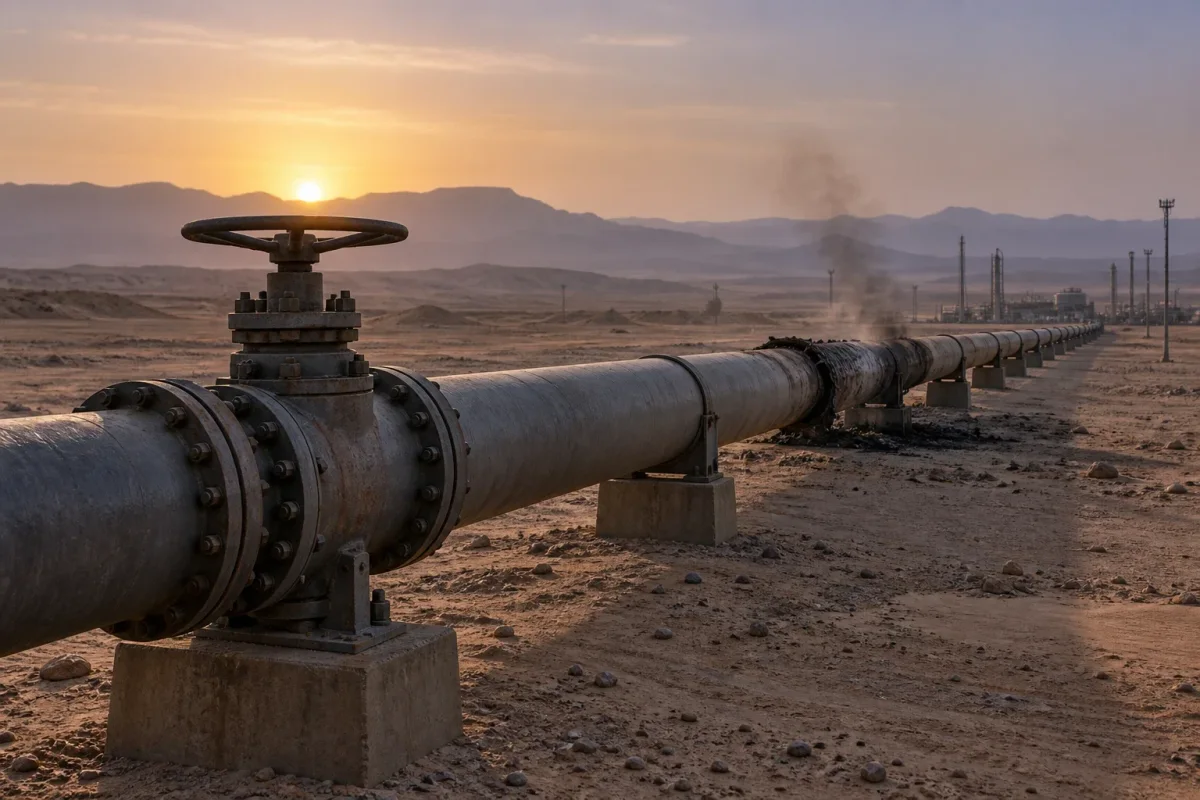
Saudi Arabia closed its East-West oil pipeline on Friday after an attack that it blamed on drones from Iranian-backed militias in Iraq. Two regional officials told The Associated Press that repairs could take three to five weeks, threatening another supply disruption as the war with Iran constrains oil shipments through the Strait of Hormuz and the Red Sea.
The roughly 1,200-kilometer (746-mile) pipeline carries crude from a processing facility near the Persian Gulf west to the Red Sea port of Yanbu. Oil loaded there can travel north toward Europe through the Suez Canal or south through the Bab el-Mandeb Strait toward Asia, allowing Saudi exports to avoid the Strait of Hormuz.
Rystad Energy said an average of 2.6 million to 4 million barrels a day had moved through the pipeline and out of Yanbu since late August. It said that volume is now at risk of disappearing from the market. Four million barrels a day represents about 4% of global oil supply, according to the International Energy Agency. Brent crude, the international benchmark, traded above $105 a barrel on Monday.
The pipeline was built in the 1980s amid concern that Tehran could disrupt Hormuz shipping during the Iran-Iraq war. It became a crucial route during the first six months of the current war, when most tanker traffic through Hormuz was at a standstill. Before the war, about 20 million barrels of oil passed through the strait each day, or roughly a fifth of the world’s supply.
Some tankers have resumed using Hormuz, but traffic remains far below prewar levels. Lloyd’s List Intelligence recorded 90 transits during the first week of September, compared with about 130 ships passing through each day before the war. Yemen’s Iran-backed Houthi rebels have also seized islands along important Red Sea shipping routes, adding another threat to Saudi exports.
Saudi Arabia produced nearly 10 million barrels of oil a day in September 2025, but output had fallen to 6 million barrels a day in August, the IEA said. Janiv Shah, Rystad Energy’s vice president of oil markets, said the recent increase in Brent prices showed the market was already responding to a significant supply loss. He said Saudi inventories could support exports in the coming days, but that the position could change quickly.