
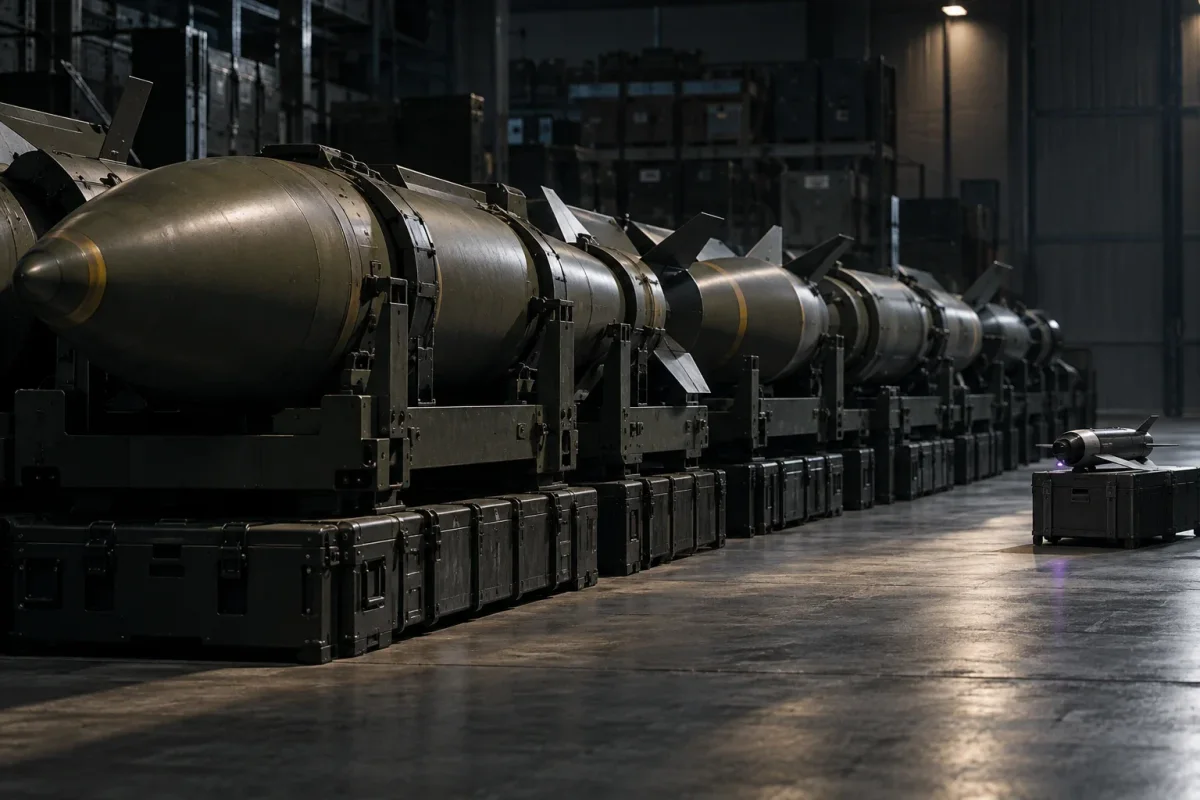
The Pentagon’s munitions plan assigns 97 percent of funding to legacy weapons and less than 3 percent to lower-cost products from new entrants, according to testimony cited from a March 2026 Senate Armed Services Committee hearing. Alex Oliver of venture-capital firm Andreessen Horowitz, or a16z, argues that shifting more procurement toward commercially developed weapons could expand U.S. stockpiles within existing budgets.
Senate Armed Services Chairman Roger Wicker told four Pentagon officials at the hearing that the United States “cannot be the Arsenal of Democracy” if it cannot deliver weapons. The article says deterrence depends on both inventories and the capacity to replace expended rounds, while citing follow-on analysis estimating that rebuilding inventories for major programs at historical production rates would take eight to fourteen years.
Oliver contrasts the prices of established systems with those advertised or targeted by newer suppliers. Tomahawk cruise missiles cost about $2 million to $4 million each, while Covenant’s Anthem and Anduril’s Barracuda family are described as costing roughly one-fifth to one-tenth as much. Lockheed Martin’s PrSM Increment 1, initially priced at $2.7 million and now $1.7 million at scale, is compared with Castelion’s Hypersonic Blackbeard GL, which is entering at under $500,000. The article’s broader performance and value comparisons are a16z’s assessment, not an independently established finding.
The article attributes part of the price difference to private financing and commercial supply chains. It says new entrants often fund development from their own balance sheets, including with capital from investors such as a16z, and design weapons around automotive, civil-aviation and consumer-electronics components. By contrast, the Pentagon’s fiscal 2025 missile and munitions request was about two-thirds procurement and one-third research and development, while government-funded development represented roughly 25 percent of overall legacy-munition costs under the calculation presented.
Several planned purchases illustrate the emerging lower-cost segment. Castelion has a framework for at least 500 Blackbeard missiles annually and a Navy program of record planning 4,510 rounds across fiscal 2027 through 2031. The Air Force’s Family of Affordable Mass Munitions plans nearly 28,000 weapons for $12.6 billion, with production starting in September 2026, while Anduril is to supply the Army at least 3,000 surface-launched Barracuda-500Ms, with initial deliveries scheduled for mid-2027.
Legacy production is also set to rise: annual PAC-3 MSE output is projected to move from about 600 interceptors toward 2,000 under a seven-year framework, THAAD from 96 toward 400, and SM-6 from 125 toward more than 500. Oliver nevertheless contends that unreliable government demand contributes to high costs, citing two decades of budgets in which funding varied by more than 50 percent year over year across 80 programs. The article advocates a mixed arsenal, retaining advanced legacy rounds for demanding targets while buying larger quantities of cheaper weapons for missions that do not require their additional capability.