
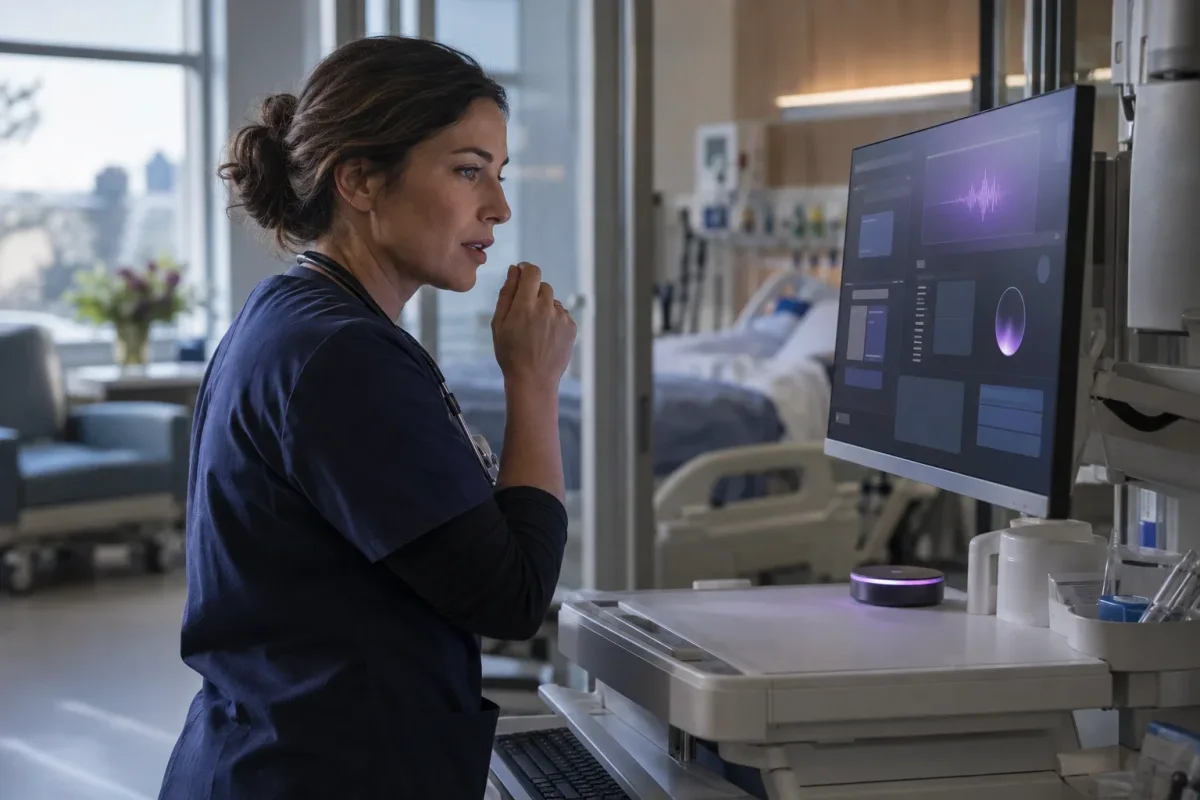
Oracle Health announced U.S. availability of Oracle Health Clinical AI Agent for nurses on September 14, 2026, embedding the capabilities directly in Oracle Health Foundation EHR for inpatient settings. The company says voice-based navigation, AI-generated acute nursing summaries and voice-enabled discrete charting can help nurses find patient information and document care in near real time.
The agent accepts natural-language voice commands for navigating and searching patient records. Its acute nursing summaries are designed to provide concise overviews of a patient’s history and current condition, while discrete charting lets nurses enter structured documentation by voice at the point of care. Oracle says these functions can reduce manual chart review, support timely documentation and improve coordination across care teams.
Oracle presented the product as a response to repetitive administrative work performed throughout nursing shifts, including reviewing records, recording care and coordinating with other clinicians. Seema Verma, executive vice president and general manager of Oracle Health and Life Sciences, said the agent provides quicker access to patient information and enables voice-powered documentation, with the aim of giving nurses more time with patients.
BayCare Health System is among the early adopters cited by Oracle. BayCare chief information officer Lynnette Clinton said Oracle Health had incorporated organizational feedback as it expanded its use of generative AI. She said completing documentation in real time has the potential to reduce after-shift charting, ease administrative work and allow nurses to focus more time on patients. Oracle also said early adopters had described the nursing features as intuitive and noted their potential to limit charting time.
The nursing release extends an existing Oracle Health portfolio intended to reduce administrative work in healthcare. According to Oracle, its Clinical AI Agent clinical-note capabilities have saved physicians more than 400,000 hours across U.S. health organizations since their launch nearly two years ago. The company says the broader system is designed to interpret clinical meaning, share context between workflows and support near-real-time automation while keeping clinicians in control.