
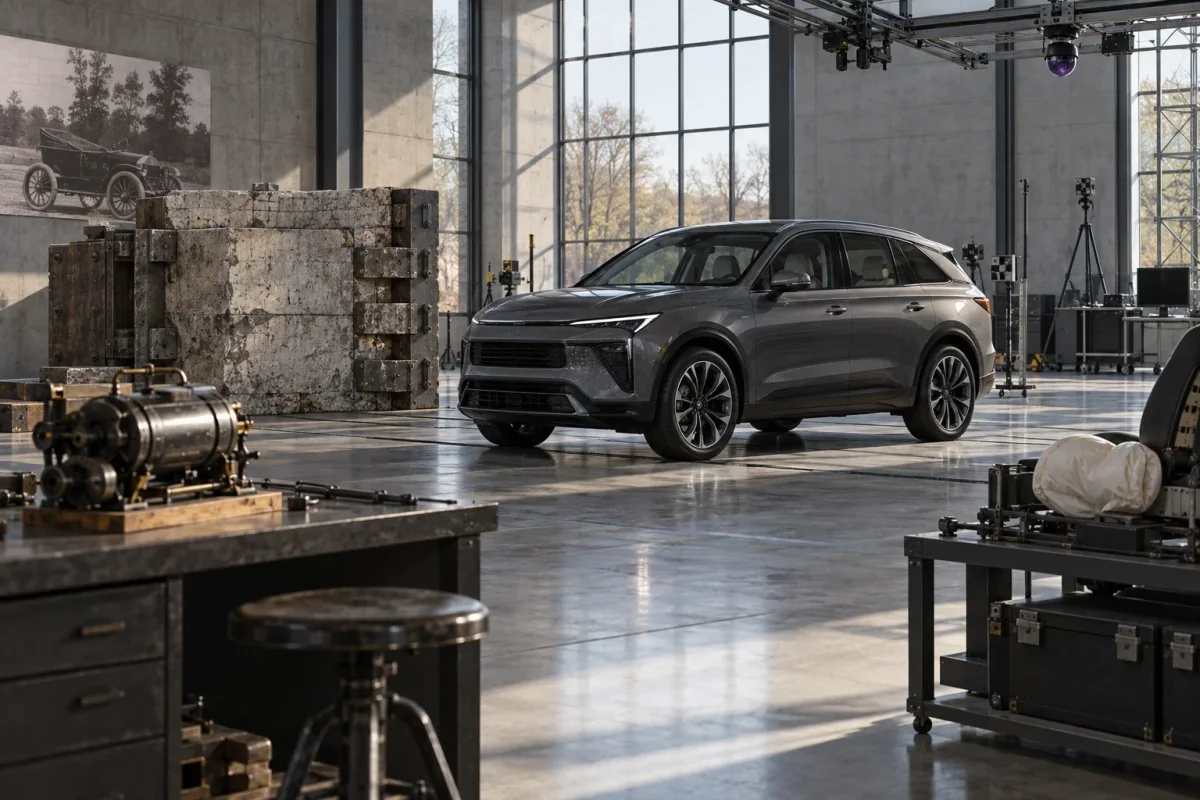
General Motors marked Global Safety Week on September 14, 2026, by presenting a timeline of vehicle-safety technologies it says the company introduced or helped develop over 114 years. The account runs from the electric self-starter on the 1912 Cadillac to five active safety features made standard on the vast majority of GM vehicles for the 2023 model year.
The company identified its Milford Proving Grounds as central to that history. GM opened the facility in 1924 and said its engineers pioneered crash testing there within about a decade, initially using methods that included pushing vehicles down a hill for rollover tests and having an engineer exit a moving car before it struck a barrier. Remote controls, sensors and cameras later enabled more realistic testing and data collection; GM opened what it described as the world’s first dedicated vehicle-rollover testing facility at Milford in 2006. The company now combines physical crashes with simulation-based validation.
GM’s timeline also covers several occupant-protection developments. In 1967, it introduced an energy-absorbing steering column designed to retract by as much as 8.25 inches in a crash and made it standard across its cars. The company also developed its Child Love Seat line during that period, including a rear-facing infant model introduced in 1969 with a dedicated harness. GM no longer manufactures child seats but says it works with manufacturers, develops virtual models for testing and partners with Safe Kids Worldwide on the Ultimate Car Seat Guide.
The Air Cushion Restraint System, which GM described as the first automotive airbag placed into production, appeared in a limited run of 1973 Chevrolet Impalas and became optional on selected Oldsmobile, Buick and Cadillac models beginning in 1974. In 1977, GM created the Hybrid III family of crash-test dummies, which it said remains an industry standard worldwide. Decades later, a front-center side airbag developed with a supplier debuted on the 2013 Chevrolet Traverse, GMC Acadia and Buick Enclave to create a cushion between front occupants during certain side-impact and rollover crashes.
GM dated OnStar to 1996, with its first deployment in 1997 Cadillac models and standard availability across the company’s lineup by 2001. The original system connected an onboard telematics module to a live OnStar Advisor after an airbag deployment so information could be relayed to first responders. Later additions included Stolen Vehicle Slowdown, Remote Ignition Block, remote diagnostics, directions, mobile connectivity and in-vehicle Wi-Fi hotspots.
More recent features include Rear Seat Reminder, introduced in 2016 and standard across GM’s four-door vehicles by 2021, and Buckle to Drive, introduced in 2019. Buckle to Drive can prevent shifting from Park for 20 seconds when the driver’s seat belt, or an occupied passenger seat belt, is unfastened. For the 2023 model year, GM made automatic emergency braking, forward collision alert, front pedestrian braking, lane-keeping assistance with lane-departure warning, and IntelliBeam automatic high-beam control standard on the vast majority of its vehicles. GM cautions that driver-assistance systems do not replace the driver’s responsibility to remain attentive and operate the vehicle safely.