
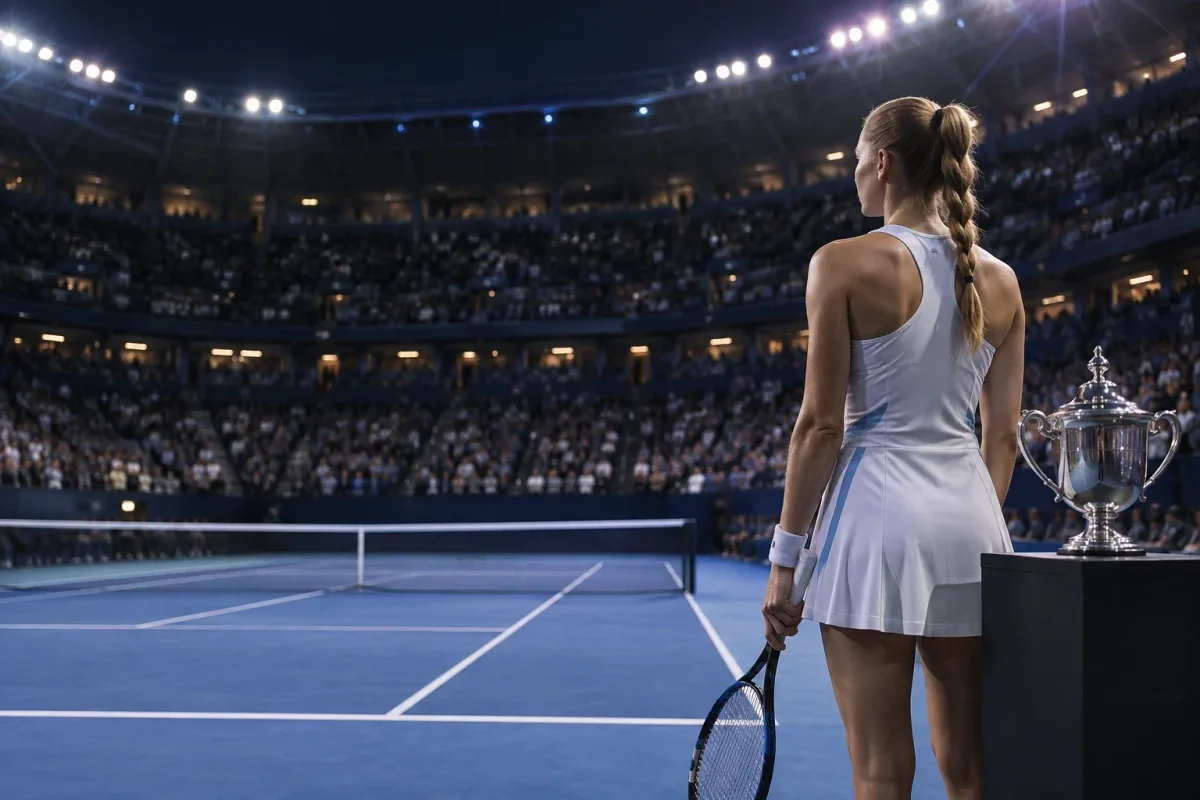
The Moscow-born star captured the 2026 U.S. Open for Kazakhstan, adding another chapter to an unusual story of talent, funding and national representation in modern professional tennis.
NEW YORK — September 12, 2026. Elena Rybakina is the U.S. Open champion.
The 27-year-old defeated Aryna Sabalenka 6–4, 5–7, 6–2 in Saturday's women's singles final at Flushing Meadows, securing her first U.S. Open trophy and the third Grand Slam title of her career. The victory also sends Rybakina to the top of women's tennis: she is set to become World No. 1, the first player representing Kazakhstan to reach that position.
It is an extraordinary achievement for Kazakhstan. But Rybakina's path to the trophy began hundreds of miles away, in Moscow.
Born and Trained in Russia
Rybakina was born in Moscow on June 17, 1999, and began playing tennis there as a child. She developed through the Russian tennis system and represented Russia during the early stages of her career.
But as she attempted the difficult transition from promising junior to professional player, money became a serious issue.
Professional tennis is unusually expensive for young athletes. Unlike athletes in many team sports, developing players often must finance coaching, travel, accommodation, training and tournament expenses long before they earn significant prize money.
Rybakina's family faced precisely that problem.
In a 2020 interview with the WTA, Rybakina described the financial difficulties her family encountered as she pursued professional tennis. The alternative was potentially accepting one of numerous offers to attend an American university.
Then Kazakhstan stepped in.
“The Kazakhstan Federation made me an offer and the decision was easier,” Rybakina recalled. “I changed my citizenship to Kazakhstan because they believed in me and they offered.”
That decision changed her career.
Kazakhstan Invested Where Russia Did Not
In 2018, at age 19, Rybakina switched her sporting allegiance from Russia to Kazakhstan.
The decision was not simply a matter of choosing another flag.
Kazakhstan's tennis federation offered the young player something essential at that stage of her career: financial and professional support. Contemporary accounts indicate that Rybakina had not received comparable financial backing from the Russian Tennis Federation.
Her father, Andrey Rybakin, later publicly criticized the level of support offered from the Russian side. Speaking after his daughter's emergence as a Grand Slam champion, he described a proposed Russian federation arrangement as financially inadequate.
Kazakhstan, meanwhile, was willing to make the investment.
At the time, there was no guarantee it would produce a Grand Slam champion.
Rybakina was a highly regarded junior but was still far from becoming one of the world's dominant professional players. She has said herself that she “was not so good when they offered” and emphasized that Kazakhstan's federation believed in her before she became an international star.
Eight years later, that decision looks remarkable.
From Moscow Prospect to Kazakhstan's World No. 1
Rybakina's rise after changing representation has been dramatic.
She won Wimbledon in 2022, becoming the first player representing Kazakhstan to win a Grand Slam singles championship. She added the Australian Open title in 2026.
Now she has conquered New York.
Her route through this year's U.S. Open included victories over Naomi Osaka, Zheng Qinwen and American star Coco Gauff before Saturday's showdown with Sabalenka.
Against the two-time defending U.S. Open champion, Rybakina took the opening set 6–4. Sabalenka responded by taking the second 7–5, but Rybakina controlled the deciding set, winning it 6–2 and claiming the championship.
The result gives Rybakina two Grand Slam titles in 2026 alone — the Australian Open and U.S. Open — and three majors overall.
She will also become the first Kazakhstani player to hold the World No. 1 ranking.
More Than a Question of Nationality
Rybakina's story inevitably raises questions about what nationality means in international professional sports.
She was born in Russia. She learned tennis in Russia. Her formative development took place in Moscow.
But Kazakhstan provided crucial support at the moment when a talented young player needed resources to continue pursuing a professional career.
Rybakina has consistently expressed appreciation for that decision rather than treating Kazakhstan merely as a convenient flag.
“It's history, and I'm very proud representing Kazakhstan,” she said during this year's U.S. Open, while discussing becoming World No. 1. She also pointed to the growing number of children playing tennis in Kazakhstan and the example her career can provide to them.
That distinction matters.
It would be too simplistic to describe Rybakina merely as a Russian athlete competing under another country's flag. Kazakhstan did not acquire an established Grand Slam champion. It backed a promising 19-year-old before anyone knew what she would become.
The investment carried risk.
The reward is now sitting in the U.S. Open trophy cabinet.
The Champion Russia Lost
There is nevertheless an unavoidable irony surrounding Rybakina's success.
One of the world's best tennis players was born and trained in Russia. Yet when her career reached the financially precarious stage between junior success and professional tennis, another country provided the backing she needed.
Today, the scoreboard identifies her as Elena Rybakina — Kazakhstan.
Wimbledon champion.
Australian Open champion.
U.S. Open champion.
World No. 1.
For Kazakhstan, Rybakina represents one of the country's greatest international sporting successes.
For Russia, her career may represent something very different: a reminder that developing talent is not only about discovering athletes. It is also about supporting them when their future is uncertain.
Kazakhstan did.
And on Saturday in New York, Elena Rybakina lifted the U.S. Open trophy under the Kazakh flag.
Jurelist | Law. Innovation. Business.