
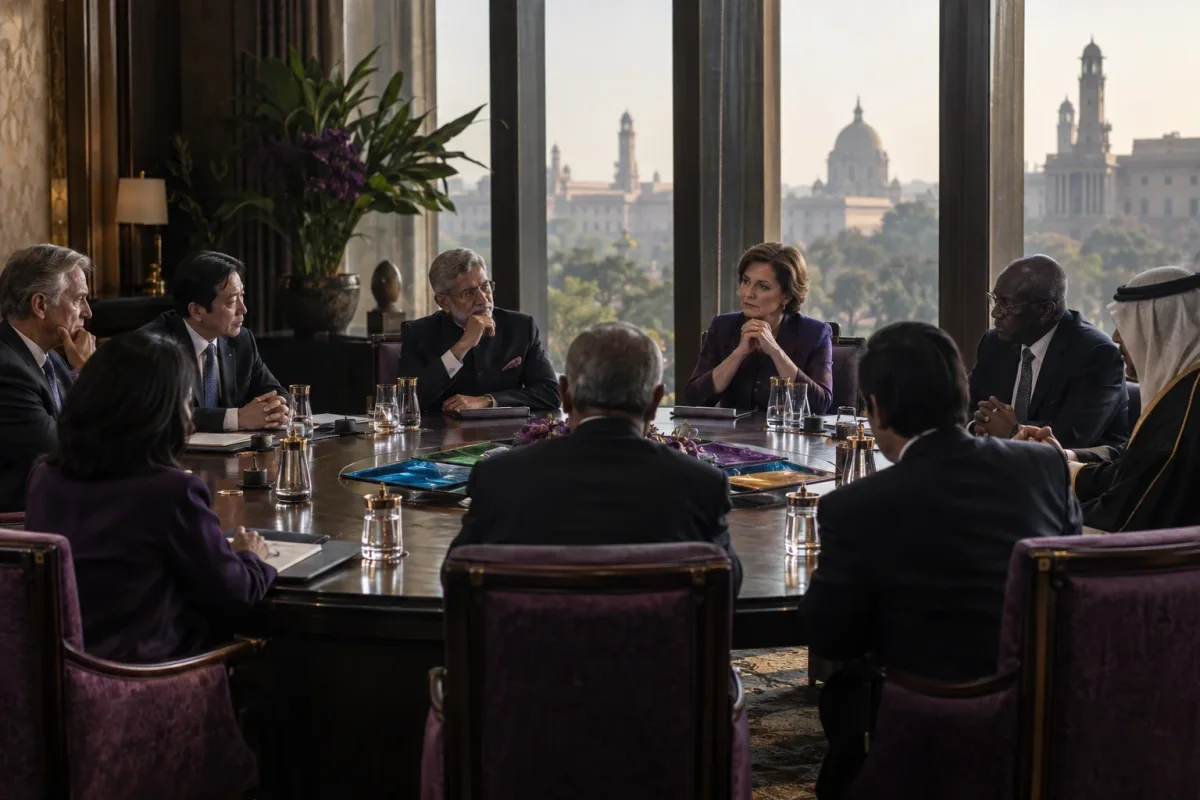
BRICS leaders meeting in New Delhi on Saturday condemned sanctions not authorized by the U.N. Security Council and expressed concern over rising tensions in the Middle East. Their joint statement called for the elimination of measures they described as unlawful and urged protection of nuclear safety and security during armed conflicts.
The statement raised concern about “deliberate attacks” on civilian infrastructure and peaceful nuclear facilities covered by safeguards of the U.N. atomic energy agency. It did not name any country in that passage, but the source described it as indirect criticism of U.S. and Israeli strikes on Iranian nuclear facilities. Iranian President Masoud Pezeshkian attended the summit.
We call for the elimination of such unlawful measures, which undermine international law and the principles and purposes of the U.N. Charter.
The leaders also did not identify particular countries when criticizing unilateral sanctions. Russia, a founding BRICS member, has faced Western sanctions since its full-scale invasion of Ukraine in 2022. The wars in Ukraine and the Middle East, together with rising U.S.-China tensions, are testing the expanded bloc’s ability to agree among members with competing geopolitical interests.
BRICS was founded in 2006 by Brazil, Russia, India and China, and South Africa joined in 2010. The group has expanded to 11 members representing about half of the world’s population and a significant share of global economic output. India hosted this year’s summit, attended by Russian President Vladimir Putin, Chinese President Xi Jinping, Pezeshkian and leaders from the other eight member countries.
Indian Prime Minister Narendra Modi sought to address concerns that the bloc was intended to oppose Western-led alliances, saying, “BRICS is not against anyone.” He said the group had reached a “coming of age” moment in which the Global South should become a “rule-shaper” in global governance and called for its unity and consensus to produce concrete outcomes.
Modi also proposed creating a BRICS seafarers’ network to improve the safety and welfare of maritime workers. The proposal came as disruptions to maritime trade linked to the war in Iran heightened risks for mariners. The bloc has increasingly sought greater representation for developing countries in global institutions while promoting alternatives to Western-dominated financial institutions.