
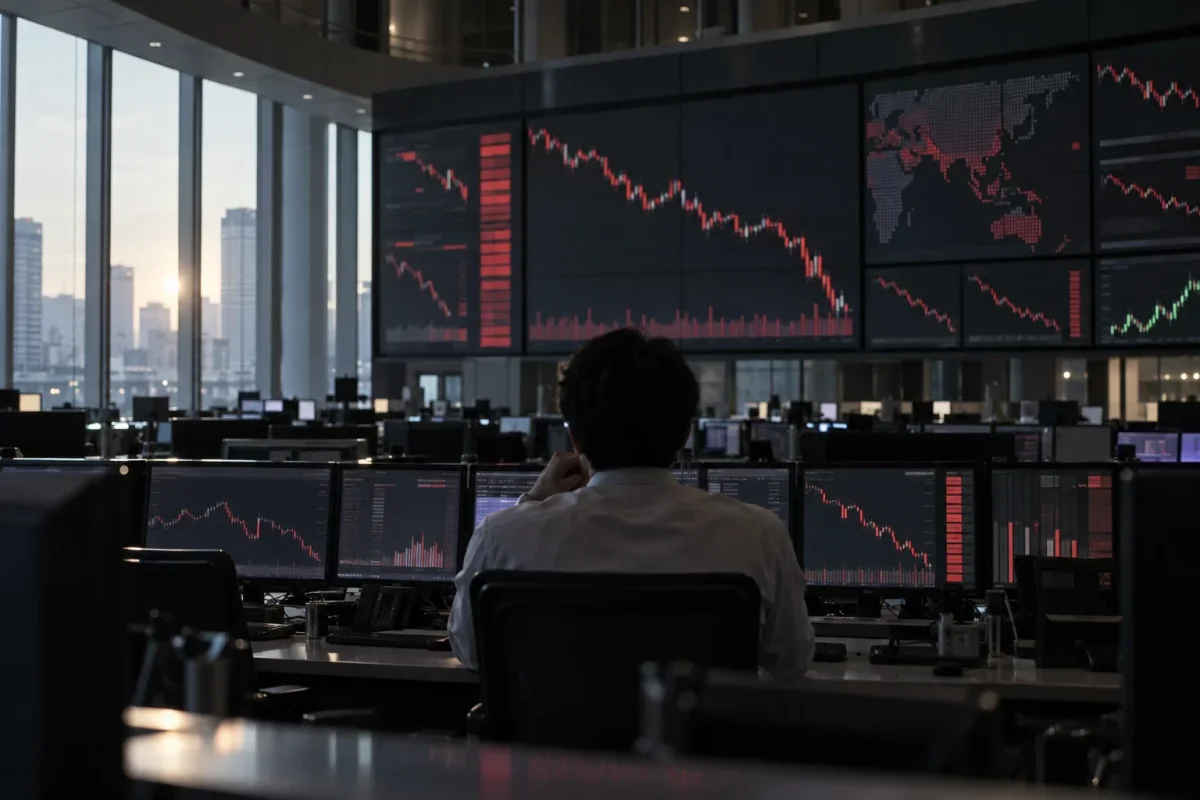
Most Asian share markets traded lower Tuesday after artificial-intelligence stocks slid on Wall Street, led by a 3.4% fall in Nvidia. Japan’s Nikkei 225 remained an exception, rising 0.2% to 63,621.08 after surrendering some stronger morning gains, while SoftBank Group rebounded about 8% in Tokyo.
The Japanese technology investor recovered its overnight losses after OpenAI Chief Executive Sam Altman told Fortune in an interview published Saturday that the ChatGPT maker would likely wait until next year for a sale of its stock on Wall Street. Such a delay would postpone a potential influx of cash for SoftBank and other early OpenAI investors.
Elsewhere in the region, Australia’s S&P/ASX 200 lost 0.9% to 8,668.30 and South Korea’s Kospi declined 0.8% to 6,628.99. Hong Kong’s Hang Seng slipped 0.6% to 24,773.37, while the Shanghai Composite fell 0.2% to 3,876.25.
AI shares have faced pressure over concerns that their prices rose too far during enthusiasm for the technology. Those concerns intensified after Anthropic CEO Dario Amodei called over the weekend for a deliberate, global slowdown in AI development, citing safety risks including the possibility that AI could become capable of directing a swarm of agents able to take over the entire internet within six to 12 months. Elon Musk said he agreed with Amodei, and SpaceX, which gets a portion of its business from AI, fell 2%.
“The prospect of a coordinated slowdown in AI development remains uncertain, given intense competition both among U.S. firms and between the U.S. and China,” Mizuho Bank analyst Ng Jing Wen said in a report.
Gains among many companies outside the AI sector limited Wall Street’s decline. The S&P 500 fell 37.00 points to 7,619.98, the Dow Jones Industrial Average dropped 152.09 points, or 0.3%, to 52,421.20, and the Nasdaq composite lost 146.62 points, or 0.6%, to 26,186.41 after recovering most of an early 1.3% decline. In energy trading, benchmark U.S. crude rose 1.84% to $103.26 a barrel and Brent crude gained 1.52% to $107.29 as fighting in the Middle East continued to restrict global crude flows.